
A system that has been running quietly for years does not start making noise for no reason. The sound is the diagnosis — you just need to know the vocabulary. Here is how our techs sort it out on a service call, and what you can safely figure out before you pick up the phone.
One rule before anything else: a noise that showed up suddenly deserves more attention than one that crept in over a season. Sudden means something moved, broke or came loose. Gradual usually means wear.
Shut it off if you hear: metal-on-metal grinding, a loud bang at start-up, or any burning smell along with the noise. Those three can turn a repair into a replacement in a matter of minutes.
1. Rattling or vibrating
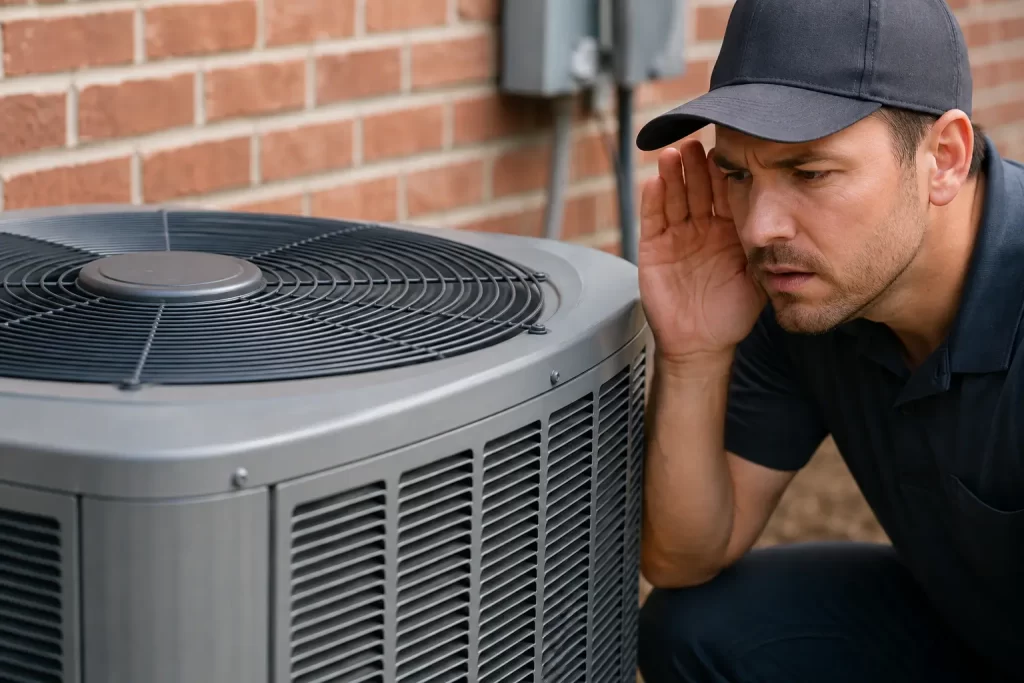
Nine times out of ten this is something loose rather than something broken: a service panel that was not screwed back down, a fan blade out of balance, or debris that found its way into the outdoor unit. It is the least alarming sound on this list — but a loose panel lets rain into the cabinet, and an unbalanced blade eventually costs you a motor.
If the rattle changes when the outdoor fan speeds up, it is almost certainly in that unit. If it happens indoors and only when the system kicks on, look at the ductwork first — sheet metal flexes and pops as it pressurizes.
2. Squealing or screeching
A high, steady squeal usually points at a belt or a bearing. On older air handlers it is the blower belt slipping; on sealed motors it is the bearings drying out. Neither fixes itself, and a seized blower motor on the coldest night of the year is the kind of call we would rather you avoid.
A short squeal at start-up that goes away after a few seconds is less urgent than one that runs the whole cycle — but write down when it started. That date tells us how fast it is progressing.
3. Banging or a hard clunk
A single hard bang at start-up on a gas furnace can be delayed ignition: gas builds up in the burner before it lights, and what you hear is a small explosion. That one is worth a same-day call — it is not something to live with while you wait for a convenient appointment.
A repeated clunk while the system runs is a different animal, usually a broken or loose compressor mount. The compressor is the most expensive part in the system, so anything that lets it move around is worth fixing early.
4. Clicking that will not stop
Clicking at start-up and shutdown is normal — that is a relay doing its job. Constant clicking with no start is usually a failing capacitor or contactor. Both are inexpensive parts, and both fail far more often than the expensive components sitting behind them, which is the good news buried in an annoying sound.
If the clicking comes with no heat at all, start with our furnace troubleshooting checklist.
5. Hissing or bubbling
Hissing from the line set points at a refrigerant leak; a bubbling or gurgling sound often means the same thing. Topping off the charge without finding the leak is money spent twice — the refrigerant goes right back out the same hole, and you are cooling the outdoors.
Refrigerant is also not something to handle yourself. It requires certification to buy and to recover, and a system that is low on charge is usually telling you about a mechanical problem, not an appetite.
6. A low hum that never stops
A humming outdoor unit that never actually starts is a classic failed start capacitor. The motor is trying to turn over and cannot. Leave it running like that and you are cooking the motor windings — turn the system off at the thermostat and call. This is one of the cheapest repairs in HVAC if you catch it early, and one of the most expensive if you do not.
What to have ready when you call
- Whether the sound happens at start-up, while running, or at shutdown.
- Whether it is coming from the indoor unit, the outdoor unit, or the ductwork.
- A ten-second phone recording of the noise. It tells us more than any description.
- The brand and model number off the data plate, if you can reach it safely.
- Roughly when it started, and whether anything changed around then — a filter swap, a storm, a power outage.
None of this is required to get us out there. But it is the difference between a tech arriving with a guess and a tech arriving with the right part on the truck.
When to stop troubleshooting and call
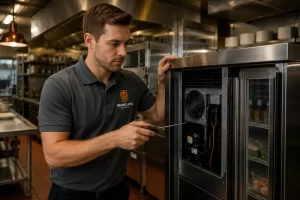
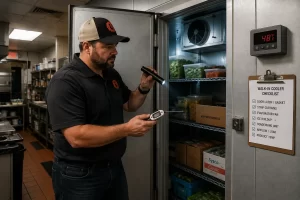
Anything on the shut-it-off list. Any noise paired with a smell. Any noise that comes with the system no longer heating or cooling properly. And anything in a commercial kitchen or walk-in, where a few hours of downtime costs more than the repair ever will.
We handle residential and commercial service across Charlotte — same-day when we can. If you are hearing something on this list, call us at (704) 771 9671 and we will tell you whether it can wait.