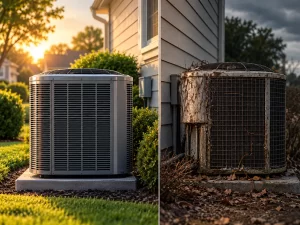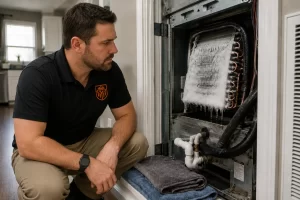

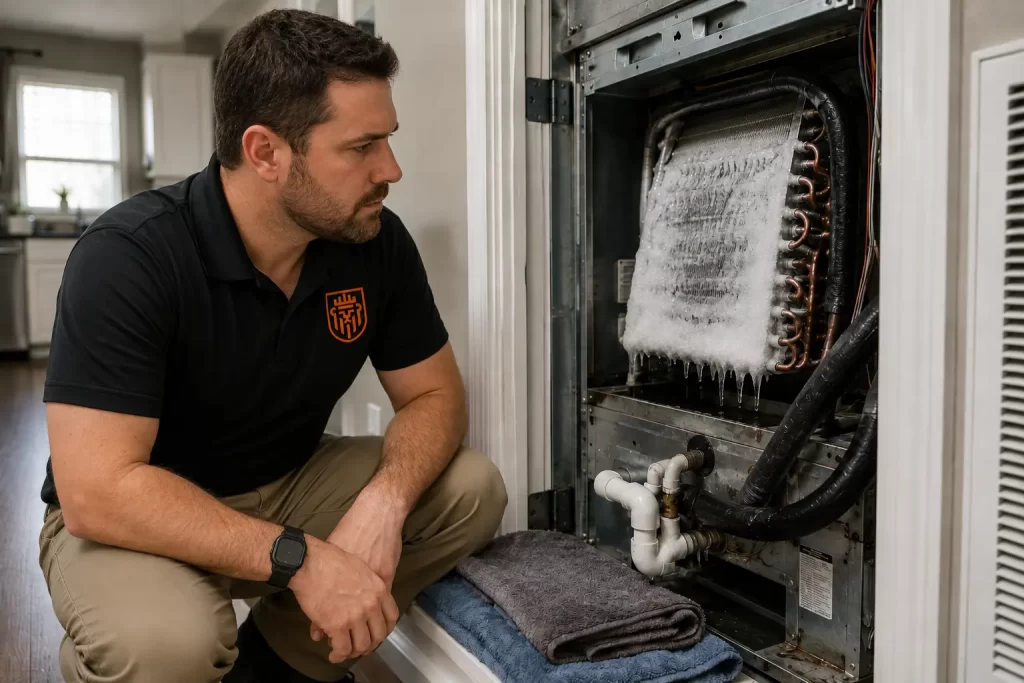
An AC freezing up in the middle of a Charlotte July feels backwards — the hotter it gets outside, the more ice on your unit. But that block of ice on the line set or coil is a symptom, not the problem. Running the system anyway makes everything worse, so here is what is actually happening and what to do in the first ten minutes.
Do this now: switch the thermostat from Cool to Off, and set the fan to On. That thaws the coil in a few hours without stressing the compressor. Put towels around the indoor unit — that ice becomes water.
Why a machine that cools makes ice
Your AC works by running refrigerant through the indoor coil at around 40°F while warm, humid indoor air blows across it. Two things keep that coil above freezing: enough warm air moving over it, and enough refrigerant at the right pressure. Take away either one and the coil temperature falls below 32°F. In Charlotte humidity, the air carries plenty of moisture to freeze onto it — which is why our summers produce so many iced units.
Cause 1: starved airflow
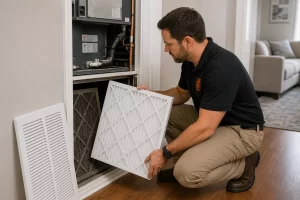
The most common cause, and the one you can fix yourself. A clogged filter, closed or blocked supply vents, or a matted indoor coil all slow the air crossing the coil, and the coil overcools itself into a block of ice. Check the filter first — if you cannot see light through it, that is likely your answer. Our filter guide also covers a subtler version of the same problem: a filter so restrictive your blower cannot pull air through it.
Cause 2: low refrigerant
Less refrigerant means lower pressure, and lower pressure means a colder coil. Refrigerant does not get used up — if it is low, it leaked. Thawing the unit and running it again buys you a day or two before it ices again, while the compressor runs hot and unlubricated. A hissing sound near the lines is a giveaway; we cover that in our guide to AC noises and what they mean.
Cause 3: a failing blower
Same starved-airflow physics, different source: a blower motor running slow, a failing capacitor, or a slipping belt on older air handlers. If the airflow from your vents feels weak with a clean filter, this is the suspect.
What thawing does and does not fix
Thawing gets you back to a working system only if the cause was a dirty filter or blocked vents you have since fixed. If the ice comes back within days, the cause is refrigerant or mechanical — and each freeze-thaw cycle floods the compressor with liquid refrigerant it was never built to pump. Compressors are the most expensive part of the system. Ice is cheap to diagnose; a dead compressor is not.
If your AC keeps freezing up, we can usually find the cause in one visit — airflow, charge and leak testing across Charlotte, NC, residential and commercial. Call (704) 771 9671, and if the unit is iced when you call, tell us — we will have you start the thaw so we can test it properly when we arrive.