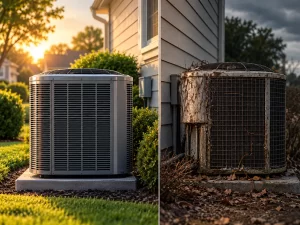

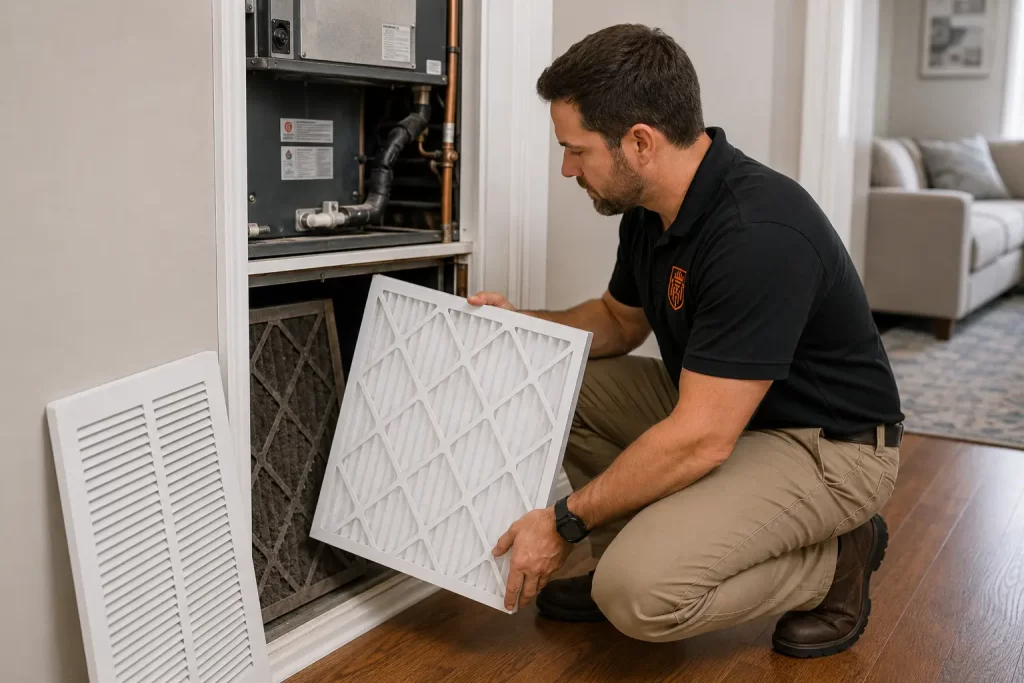
Walk down the filter aisle and the story you are told is simple: higher MERV rating, better filter. For your lungs, mostly true. For your HVAC system, not so fast — the wrong HVAC filter is one of the quietest ways to shorten the life of a blower motor. Here is how to pick a filter your system can actually breathe through, and how often to really change it.
What MERV ratings actually mean
MERV (Minimum Efficiency Reporting Value) measures how small a particle the filter catches, from 1 to 16 for residential filters. The practical bands:
- MERV 1–4 — the flat fiberglass panel. Stops rocks and moths. Protects the equipment, not your air.
- MERV 8 — the sensible default. Dust, pollen, dust mites. Good balance of filtration and airflow for most homes.
- MERV 11 — pet dander, finer pollen. The right call for allergy households, IF the system can handle it.
- MERV 13 — smoke, bacteria-sized particles. What hospitals and post-2020 commercial specs ask for. Real resistance to airflow.
The part the box does not say
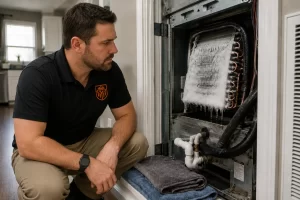
Every step up in MERV is a step up in resistance. Your blower was sized for a certain pressure drop; a dense 1-inch MERV 13 in a system designed for a MERV 8 makes the blower work harder for less air. The results show up as cold rooms at the end of runs, a furnace tripping on overheat, and in summer, an iced-up AC coil — starved airflow is the number one cause of freezing we find in Charlotte homes.
The fix if you want high filtration: thickness. A 4-inch MERV 11 media filter has far more surface area than a 1-inch, so it filters better AND breathes easier. If your return can take a media cabinet, that upgrade is worth more than any 1-inch filter on the shelf.
How often to actually change it
Forget the printed “90 days” — it assumes a house with no pets, no carpet and nobody home. Real-world Charlotte schedules:
- 1-inch filter, no pets: every 60 days.
- 1-inch filter, pets or allergies: every 30–45 days.
- 4-inch media filter: every 6 months, checked at 4.
- Any filter during pollen season or renovation dust: check monthly.
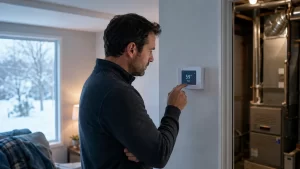
The reliable test costs nothing: hold it up to a light. If light does not pass, air is not passing either. A clogged filter is also the first thing to rule out when a furnace stops heating — it chokes airflow until the furnace shuts itself down on a safety.
Get the size right
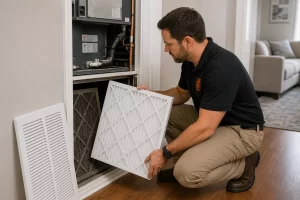
The size is printed on the filter frame (like 16x25x1) — but frames lie a little; those are nominal sizes. If your filter whistles, rattles, or slides around, air is going around it instead of through it, and an unfiltered bypass ends up coating the coil. Measure the slot itself if in doubt.
Not sure what your system was designed to handle? Next time we are out for a tune-up or repair in Charlotte, NC, ask — checking static pressure takes us two minutes and tells you exactly how much filter your blower can afford. Call (704) 771 9671.