Charlotte, NC · Commercial HVAC
Commercial HVAC in Charlotte, NC: keep the doors open.
When the HVAC goes down at a restaurant, office or brewery, you lose more than comfort. Customers walk out, staff overheat and equipment suffers. This guide covers the systems Charlotte businesses run on and how to keep them running.

Quick answer
Most Charlotte businesses run on rooftop package units (RTUs) or commercial split systems. They should be serviced quarterly, with filters changed more often in kitchens, gyms and dusty spaces. The most costly problems are electrical failures in summer, clogged condensate drains and kitchen exhaust that's out of balance with make-up air. A maintenance schedule and a contractor who knows your equipment prevent most emergency calls.
The systems Charlotte businesses run on
A walk through South End, NoDa, Uptown or the shopping centers along South Boulevard and in Ballantyne shows the same equipment again and again. Here's what we see most often:
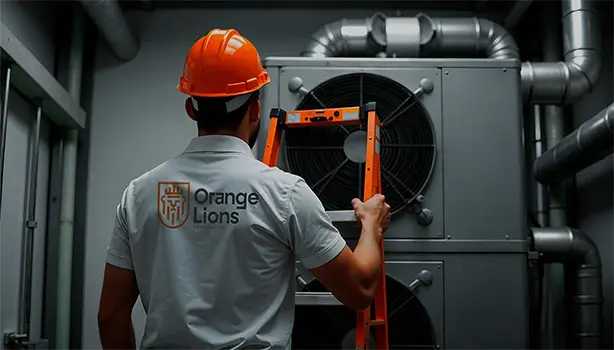
- Rooftop package units (RTUs). Everything sits in one box on the roof: compressor, coils, blower and often gas heat. These are standard for strip-center retail, restaurants and single-story offices. They're out of sight, which is exactly why they get neglected.
- Commercial split systems. An outdoor condenser is paired with an indoor air handler or furnace. These are common in converted older buildings, small offices and multi-tenant spaces.
- Ductless mini-splits. These cool server rooms, add-on spaces, offices inside warehouses and brewery taprooms where running new ductwork doesn't make sense.
- Make-up air units and exhaust hoods. Any commercial kitchen that pulls air out through a hood needs a way to bring fresh air back in.
- Unit heaters and exhaust fans. You'll find these in warehouses, shops and brewery production floors, where you need to heat or ventilate a space rather than fully condition it.
Make-up air and kitchen exhaust: the hidden comfort problem
A kitchen exhaust hood can pull thousands of cubic feet of air out of the building every minute. That air has to be replaced. If the make-up air unit is undersized, broken or turned off to "save money," the building goes into negative pressure, and the results are easy to spot:
- Front doors that are hard to open or slam shut on their own
- Hot, humid outdoor air pulled in through every gap, especially in Charlotte summers
- A dining room that never feels cool even though the RTUs run constantly
- Smoke and odors that roll out of the hood instead of going up it
- Gas appliances and water heaters that may not vent properly, which is a safety issue
The fix isn't a bigger AC. The supply and exhaust need to be measured and brought back into balance, and the make-up air unit needs to work. If it's heated or tempered, it should also deliver air at a reasonable temperature. We check this during commercial maintenance visits for any space with a hood.
What commercial HVAC maintenance includes
Commercial equipment runs longer hours than home systems and deals with grease, dust, roof heat and heavy occupancy. A quarterly schedule fits most Charlotte businesses:
| Quarter | Focus | Typical tasks |
|---|---|---|
| Spring (Mar – May) | Cooling startup | Coil cleaning after pollen season, refrigerant and electrical checks, capacitor and contactor tests, drain flush, belt check |
| Summer (Jun – Aug) | Peak-load check | Filters, drain lines and float switches, condenser coil rinse, amp draws, economizer operation |
| Fall (Sep – Nov) | Heating startup | Gas heat section, burners and flame sensor, heat exchanger inspection, CO check, heat pump defrost test |
| Winter (Dec – Feb) | Mid-season check | Filters, belts, blower bearings, thermostat and controls, roof curb and panel condition |
Each visit should end with a written report that lists every unit, readings, what was done and what needs attention. If you manage several locations or a multi-tenant building, that record is what lets you budget for repairs instead of getting surprised by them.
Common rooftop unit failures we see in Charlotte
Most RTU emergency calls trace back to a handful of causes, and most of them show warning signs first:
- Failed capacitors and contactors. Heat and long run hours wear them out. They're cheap to replace during maintenance and expensive to find on a 95°F Saturday.
- Condenser fan motor failure. The compressor overheats and trips, and the unit blows warm air.
- Clogged condensate drains. In our humidity, a clogged drain can leak through the roof deck or into the ceiling. Water stains on ceiling tiles under an RTU are a classic sign.
- Broken or slipping belts. On belt-drive units, the blower stops moving air, so the unit runs but nothing comes out of the vents.
- Dirty or damaged coils. Pollen, cottonwood, grease and hail-bent fins cut capacity, so the unit runs nonstop without catching up.
- Economizer problems. A damper stuck open brings in hot, humid air in summer and cold air in winter, which drives up energy costs.
- Refrigerant leaks. These usually show up at brazed joints or on coils. Adding refrigerant over and over without finding the leak only delays the repair.
What downtime really costs
For a home, a broken AC is a bad night. For a business, it shows up on the books:
- Restaurants and bars: guests leave, kitchen staff work in dangerous heat, and refrigeration equipment near the line struggles in a hot room.
- Retail: shoppers leave a hot store fast, and some merchandise doesn't handle heat and humidity well.
- Offices: productivity drops, server and network closets overheat, and tenants complain to the landlord.
- Breweries and food production: temperature and humidity control affects the product itself, not just comfort.
Emergency service also tends to cost more than planned work, especially after hours. We break down the numbers for kitchens in what a refrigeration emergency really costs. The same logic applies to HVAC.
Planning a commercial HVAC replacement
Replacing an RTU isn't a same-day swap. Planning ahead keeps costs down and the business open:
Start before it fails
If a unit is past 15 years old, uses R-22, or has needed several major repairs, start planning now rather than during a July breakdown. Equipment lead times, crane availability and permits all take time.
Curb adapters and crane lifts
A new unit often has a different footprint from the old one, so it may need a curb adapter. Most RTU swaps need a crane, and in dense areas like Uptown or South End that can also mean scheduling around street access.
Permits and inspection
Commercial HVAC replacement in Charlotte generally requires a mechanical permit and inspection through Mecklenburg County Code Enforcement, or through the county for locations outside Mecklenburg. Your contractor should handle the permit. If a quote says no permit is needed, ask why.
Working around your hours
Swaps can often be scheduled early in the morning, after close or on slower days. Talk timing through up front so the old unit doesn't come off the roof during your busiest service.
For a look at what drives replacement pricing, see our guide to HVAC replacement costs in Charlotte.
Where HVAC and commercial refrigeration meet
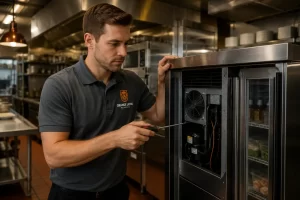
In restaurants, bars and convenience stores, HVAC and refrigeration work as one system. A hot kitchen makes reach-ins, ice machines and walk-in condensers work harder. A walk-in condenser that dumps heat into a poorly ventilated room makes the HVAC work harder. When either one fails, the other usually starts struggling soon after.
That's why it helps to have one licensed team that services both. If your walk-in is running warm, start with our 20-minute walk-in cooler triage, then call us at (704) 771-9671.

Written by the Orange Lions Mechanical teamLicensed HVAC and refrigeration contractor in Charlotte, NC (State License #36527). Residential and commercial service across Mecklenburg, Union, Cabarrus and Gaston counties.